If you’re managing a growing business, you know that traditional financial reports can only tell you so much. You might be able to see how your business is doing overall, but what about performance by department, region, product line, or customer type?
That’s where multi-dimensional accounting in Intuit Enterprise Suite (IES) comes in. It lets you break down your financial data in more meaningful ways — so you can make better, faster decisions. That’s what you’ll see in this article.
Key Takeaways
- Multi-dimensional accounting lets you track and report on multiple custom attributes (or “dimensions”) in your business.
- It’s different from traditional systems that only report based on chart of accounts or simple categories.
- Intuit Enterprise Suite brings this powerful functionality to QuickBooks users who are ready to level up.
What Is Multi-Dimensional Accounting?
In a traditional system, your financial reports usually reflect one or two things: accounts and maybe classes or locations. But modern businesses often need more depth.
Multi-dimensional accounting allows you to tag each transaction with multiple pieces of information — called dimensions like:
- Department
- Product or service
- Region or territory
- Customer segment
- Project or job name
With those dimensions in place, you can instantly run reports like:
- Profitability by product line
- Expenses by region
- Revenue by project
- Trends across departments
And you don’t have to export to Excel or spend hours cleaning up data. It’s all right there, in IES.
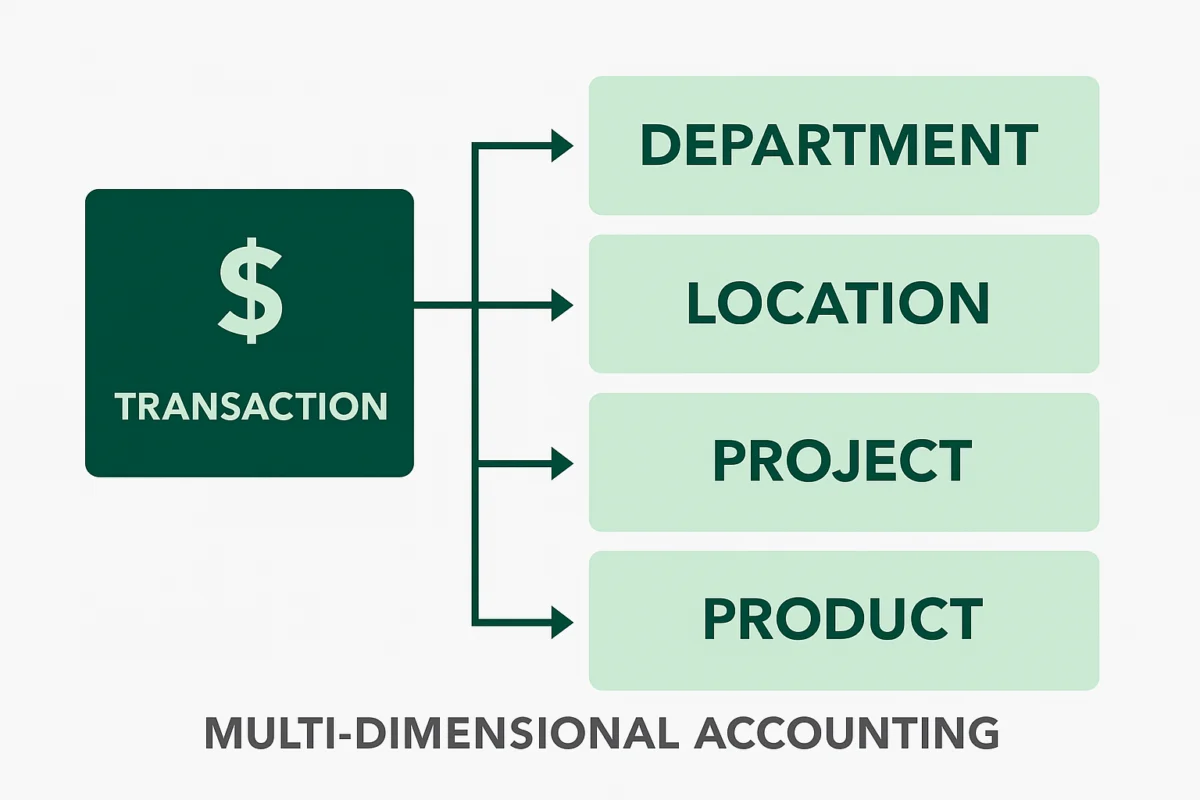
Visualizing Multi-Dimensional Accounting: One transaction can be tagged with key dimensions—like department, location, product, and project—to unlock more meaningful financial reporting in Intuit Enterprise Suite.
How It Helps You Run Your Business Better
Even if you’re not an accounting expert, you know the power of a good report. Multi-dimensional accounting:
- Gives you clarity into what’s working and what’s not
- Helps you allocate resources more effectively
- Supports more thoughtful planning and forecasting
- Reduces the need for manual reporting workarounds
In short, it helps you make more confident, informed business decisions.
How It Helps Finance Teams
For controllers, CFOs, and accountants, dimensions are a game-changer:
- Clean, consistent data with less risk of error
- Advanced reporting without spreadsheet gymnastics
- Flexible structure for scaling the chart of accounts
It’s powerful, professional-grade accounting built into a familiar system.
Is This in Other QuickBooks Products?
Sort of, but not like this.
- QuickBooks Desktop Enterprise offers class and location tracking, which is useful but limited to two levels of categorization.
- QuickBooks Online Advanced also allows for some additional tagging.
- But Intuit Enterprise Suite’s multi-dimensional accounting lets you define multiple, customized dimensions and use them across your entire accounting workflow.
It’s built for businesses with more complex needs that want to keep using a QuickBooks-based solution.
Why It Matters Now
As businesses grow and diversify, being able to see why something is happening financially is just as important as seeing what is happening.
Multi-dimensional accounting is the answer for:
- Businesses with multiple locations or product lines
- Teams that need clearer visibility into profitability and costs
- Organizations tired of juggling spreadsheets and disconnected reports
Want to Learn More?
If you’re not sure whether this is the right move for your business, we’re happy to help. At Peak Advisers, we specialize in helping small businesses implement and get the most out of Intuit Enterprise Suite.
Let’s talk. Contact us for a free consultation.
And check out our other helpful content:
- What Is Intuit Enterprise Suite?
- QuickBooks Desktop vs Intuit Enterprise Suite
- Smarter Reporting with Intuit Enterprise Suite
FAQ
What is multi-dimensional accounting?
Multi-dimensional accounting is a way to track and analyze financial data across multiple dimensions—such as department, location, project, program, or customer type—without creating an overly complex chart of accounts. Instead of relying on a single account structure, transactions are tagged with attributes that allow more flexible and meaningful reporting.
How is multi-dimensional accounting different from using classes or locations in QuickBooks?
Classes and locations in QuickBooks provide limited segmentation, but they don’t scale well as reporting needs grow. Multi-dimensional accounting allows you to analyze the same transaction across several dimensions at once, offering deeper insight without forcing you to create duplicate accounts or rely heavily on spreadsheets.
Why is multi-dimensional accounting important for growing businesses?
As businesses grow, financial questions become more complex. Leaders want to understand profitability by service line, region, program, or project—not just at the company level. Multi-dimensional accounting provides clearer insight, faster reporting, and better decision-making as operational complexity increases.
When does a business typically need multi-dimensional accounting?
Most businesses begin needing multi-dimensional accounting when they manage multiple entities, departments, funding sources, or project types. If generating useful reports requires exporting data to Excel or maintaining parallel tracking systems, it’s often a sign that basic accounting structures are no longer sufficient.
Does QuickBooks support true multi-dimensional accounting?
QuickBooks offers limited dimensional tracking through features like classes and locations, but it is not designed for full multi-dimensional accounting at scale. Businesses with advanced reporting needs often require more robust systems—such as Intuit Enterprise Suite—to support multiple dimensions without workarounds.