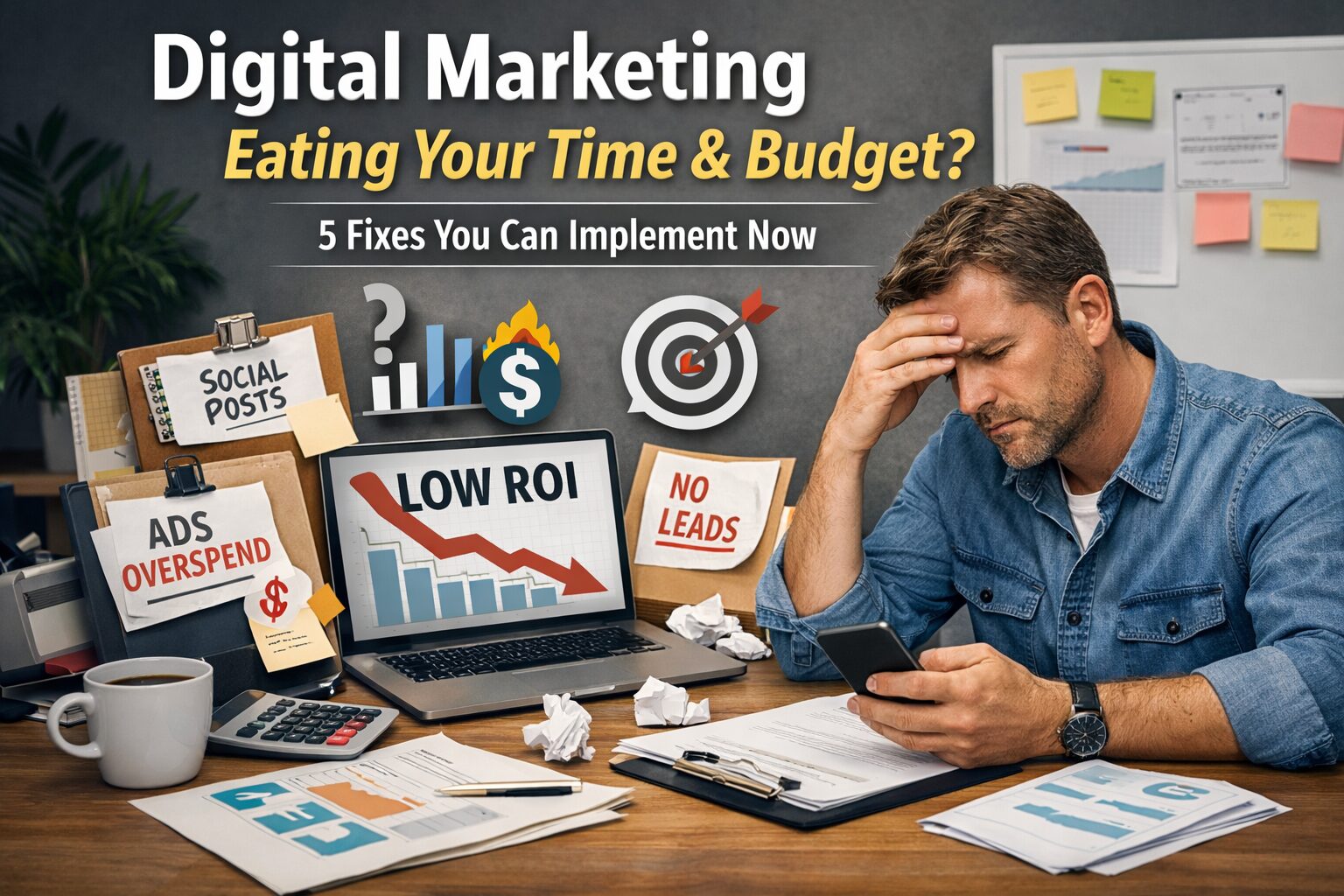
You’re spending hours on social posts, blog ideas, and ad tweaks—but your phone isn’t ringing, your inbox is quiet, and your calendar stays wide open.
You’ve watched the tutorials. You’ve boosted posts. You’ve tried Google Ads, email newsletters, maybe even SEO. And somehow, small business digital marketing keeps demanding more time and more money without giving much back.
Here’s the important part: this isn’t happening because you’re bad at marketing.
It’s happening because most small business owners are handed tools without a strategy. You’re expected to be the marketer, copywriter, designer, analyst, and business owner—all at once. DIY marketing turns into guesswork, wasted ad spend, and burnout fast.
The good news? You don’t need a full overhaul, a massive budget, or a 12-month plan to turn this around.
This article walks through five high-impact fixes you can implement this month. They’re designed to save time, cut waste, and start generating real leads—without fluff, jargon, or endless busywork.
Key takeaways
- Most small business marketing fails because tactics are disconnected from strategy
- Basic conversion tracking can reveal what’s working within 30 days
- Content built around real customer questions outperforms keyword stuffing
- Simple marketing automation prevents leads from going cold
- Repurposing content reduces workload while improving consistency
Why small business marketing feels like a money pit
For many owners, marketing feels like pouring money and time into a black hole.
A few common reasons:
- Tactics without strategy. Random social posts, scattered ads, and blog topics chosen on the fly.
- No tracking or measurement. If you can’t see what’s driving calls or form fills, every dollar feels risky.
- DIY overload. You’re trying to run the business and manage content, ads, SEO, and follow-ups.
When everything feels urgent, nothing feels effective. (That’s exactly why we built our digital marketing services specifically for time-strapped small business owners.)
The good news is you don’t need to do more marketing. You need to do less—but better. Start with the fixes below.
Fix #1: Stop guessing—track what actually brings in leads
The problem:
Most small businesses don’t actually know where their leads come from. They might suspect Google, referrals, or ads—but they can’t prove it.
Without conversion tracking, every decision is a guess. That’s how marketing budgets get wasted.
The fix:
Set up basic, no-nonsense conversion tracking so you can see what’s driving inquiries.
This doesn’t require advanced dashboards or expensive tools. At a minimum, you should be tracking:
- Contact form submissions
- Phone calls from your website
- Email inquiries
- Appointment bookings
Google Analytics, Google Tag Manager, and basic call tracking tools are enough to get started.
Action step:
This week, add a simple “How did you hear about us?” field to your contact form. Log the answers in a spreadsheet or CRM.
It’s not fancy—but it works.
Why it matters:
Within 30 days, you’ll know which channels deserve your time and which ones are draining your marketing budget without results.
Fix #2: Focus on search intent, not just keywords
The problem:
Many small business owners hear “SEO” and immediately think “keywords.” So they write blog posts around phrases that technically get searches—but don’t actually convert.
Traffic goes up. Leads don’t.
That’s because keywords without search intent miss the mark.
The fix:
Create content that answers the exact questions your ideal customers are already asking—right before they’re ready to buy or call.
Examples:
- “How much does commercial roof repair cost in Denver?”
- “Why does my QuickBooks file keep crashing?”
- “When should a small business outsource marketing?”
These aren’t fluffy blog topics. They’re decision-making questions.
Action step:
Look at the last month of emails, calls, and sales conversations. Identify your top five customer questions.
Write one blog post per question.
If you’re stuck, use placeholders like:
- [LINK: related blog post on automation]
- [LINK: related blog post on SEO basics]
You can refine later. Getting started is the win.
Why it matters:
Content aligned with search intent ranks better in Google, performs well in AI-generated answers, and attracts visitors who actually become leads.
Fix #3: Automate follow-up so no lead falls through the cracks
The problem:
Leads come in—but you’re busy. A day passes. Then two. By the time you follow up, the prospect has moved on.
Slow response times quietly kill lead generation.
The fix:
Set up a simple marketing automation sequence that responds instantly and follows up consistently.
You don’t need a complex funnel. A basic three-email sequence works:
- Immediate response: Confirms their inquiry and sets expectations
- 3-day follow-up: Checks in and answers common questions
- 7-day follow-up: Shares a case study, testimonial, or clear next step
Tools like Mailchimp, HubSpot, or ActiveCampaign can handle this with minimal setup.
Action step:
Block one hour this week to create a three-email follow-up series and connect it to your contact form.
That’s it.
Why it matters:
Leads stay warm even when you’re slammed, response time improves, and your close rate increases without extra effort.
Fix #4: Cut underperforming ads and double down on what works
The problem:
Many small businesses set up ads and then forget about them. Facebook or Google keeps charging. Results stay flat. Wasted ad spend piles up.
If you’re not reviewing performance, you’re flying blind.
The fix:
Ad performance doesn’t need daily micromanagement—but it does need regular check-ins.
Focus on just a few metrics:
- Cost per lead
- Conversion rate
- Actual inquiries generated (not clicks)
Pause anything that’s consistently over your acceptable cost per lead.
Action step:
Schedule a 15-minute weekly ad audit on your calendar. Same day, same time, every week.
During that block:
- Pause underperformers
- Shift budget to what’s working
- Write down one thing to test next week
Why it matters:
You stop bleeding money, regain control of your marketing budget, and start seeing ROI from paid campaigns instead of frustration.
Fix #5: Repurpose one great piece of content into five assets
The problem:
Content creation becomes exhausting because you’re always starting from scratch.
New blog. New social post. New email. New idea.
That’s a recipe for burnout.
The fix:
Create one strong piece of content and repurpose it across channels.
One solid blog post can become:
- A newsletter article
- Two or three social posts
- A short video script
- An FAQ page
- A follow-up email
Consistency beats volume every time.
Action step:
Find your best-performing blog post or client success story from the past year.
This month, turn it into three additional assets—not five, not ten. Three.
Why it matters:
You get more reach, more consistency, and less work—without diluting your message.
When to bring in help (and what that looks like)
These five fixes will give you breathing room. For many small business owners, they’re enough to stop the bleeding and regain control.
But there’s a point where DIY marketing hits a ceiling.
It’s usually time to bring in help when:
- You’re executing tactics but don’t have time to build or manage the strategy
- You need consistent, high-quality content but can’t write it yourself
- You want conversion tracking and marketing automation set up correctly, not halfway
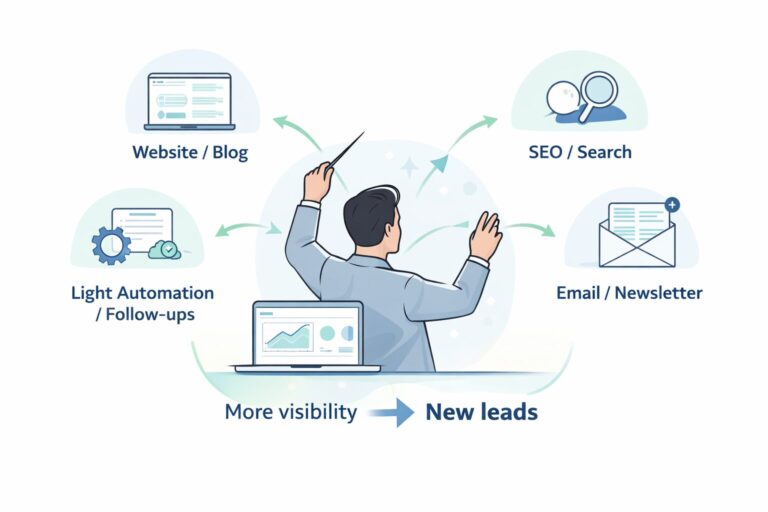
A good digital marketing partner doesn’t just “post content.” They connect SEO, content, automation, and lead tracking into a system that works together.
At Peak Advisers, our digital marketing services focus on:
- AI-powered SEO built around search intent
- Custom newsletters and blog writing
- Lead tracking and marketing automation
- Practical reporting you can actually understand
You can explore our full approach here:
If you’d rather talk through your situation first:
No pressure. Just clarity.
The Bottom Line
If small business digital marketing feels like it’s eating your time and budget, the problem isn’t effort—it’s focus.
By:
- Tracking what actually generates leads
- Writing content around real customer questions
- Automating follow-up
- Managing ads intentionally
- Repurposing what already works
you can reduce wasted time, cut wasted ad spend, and start seeing traction without doing more work.
Small, strategic changes compound quickly.
If you’re ready to stop guessing and start growing, schedule a free consultation.
Or explore how we help small businesses build smarter systems.
FAQ
How long does it take to see results from small business digital marketing?
You can usually spot early signals—better inquiries, clearer data, improved follow-up—within 30 days if tracking and intent-based content are in place. Meaningful lead growth typically builds over 60–90 days. Marketing compounds over time, but it shouldn’t feel invisible in the short term.
Do I need expensive tools to track leads and conversions?
No. Most small businesses can get solid conversion tracking using tools they already have or low-cost options. Website form tracking, basic Google Analytics, call tracking, and a simple CRM or spreadsheet are enough to understand what’s working and what isn’t.
Is SEO still worth it with AI search and Google changes?
Yes—especially when SEO is built around search intent, not keyword stuffing. AI-driven search tools still rely on clear, helpful content that answers real questions. Businesses that publish practical, experience-based content continue to show up in both traditional search results and AI-generated answers.
What’s a realistic marketing budget for a small business?
There’s no universal number, but most small businesses invest 5–10% of revenue in marketing when growth is a priority. The bigger issue isn’t the size of the budget—it’s whether that budget is tracked, focused, and tied to lead generation instead of vanity metrics.
When should a small business stop doing DIY marketing?
DIY marketing makes sense early on, but it starts breaking down when it consistently steals time from running the business or produces inconsistent results. If you’re doing the work but don’t have time to plan, measure, or improve it, that’s usually the tipping point.
What does a digital marketing partner actually handle for me?
A good partner doesn’t just post content or run ads. They build and manage the system—strategy, content, SEO, automation, and tracking—so leads come in consistently and you know what’s driving them. That’s the gap most small businesses struggle to fill on their own.